
Building Immersive Experiences
a framework for participatory performance

When I set out to develop scripts for immersive theater that could activate audiences and spark dialogue around social issues, I found myself drawing from unexpected sources: tabletop role-playing games, educational simulations, live action role-plays, and even Red Cross training scenarios. From these points of departure, I developed a seven-part framework for scripting immersive theater experiences.
This structure is a flexible foundation that can be adapted based on the specific needs of each performance.
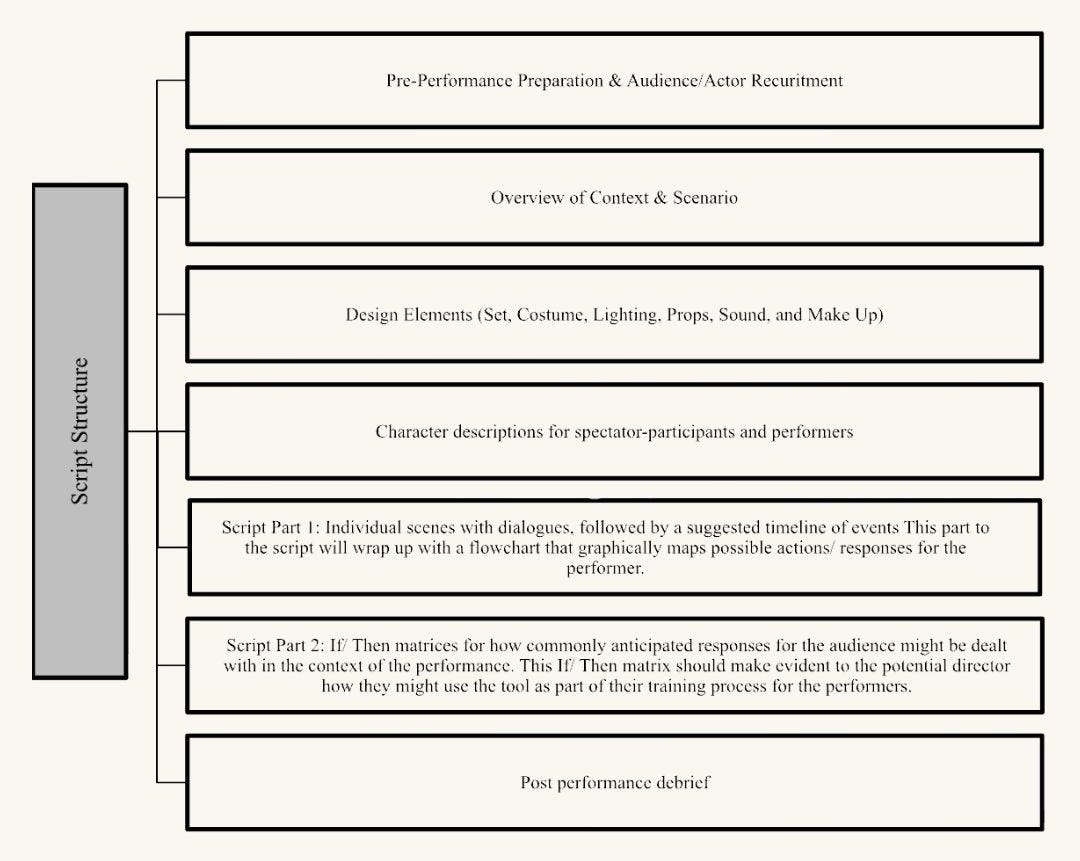
1. Pre-Performance Preparation & Audience/Actor Recruitment
Before anyone enters the space, the groundwork matters. Who are your participants? What do they need to know before they arrive?
2. Overview of Context & Scenario
Establishing the world of the performance: the when, where, and why that orients everyone involved.
3. Design Elements
The sensory landscape: set, costume, lighting, props, sound, and makeup.
4. Character Descriptions
Both spectator-participants and performers need to understand who they are (or might become) in this space.
5. Script Part 1: Individual Scenes & Event Timeline
Specific dialogues and moments, culminating in a flowchart that maps possible actions and responses for the performer.
6. Script Part 2: If/Then Matrices
Anticipated audience responses and how they might be addressed within the performance context. This becomes a training tool for performers, helping them navigate the unknown.
7. Post-Performance Debrief
The conversation after the experience, often where the most important transformation happens.
Exercise: Map Your Own Immersive Experience
Whether you’re designing a theater piece, a workshop, a game, or any participatory experience, try working through this framework:
Choose a social issue or human experience you want to explore.
Sketch out answers to these questions:
What’s one scenario that would activate this issue?
What characters would the performers play?
What is the role of the audience?
Design one key moment of choice and create a simple flowchart: What are three possible ways an audience member might react to a choice they are given?
For each response, sketch out what happens next i.e., how the performers might adapt the scenario based on the reactions of the audience.
Post your scenario sketch in the comments, or if you’d prefer, work through it privately and note what you discovered about your own design process.
This post is adapted from my book Immersive Theater and Activism, which explores how participatory performance can be designed to catalyze social change and dialogue.